Introduction
The Korean Wave (Hallyu; 韓流), a term for the popularity of South Korean popular culture in other countries, started to spread out in Asian states in the late 1990’s. In Japan, the Korean Wave expanded around 2004. At the center of this stream were female audiences who liked Korean popculture, especially TV dramas and actors. Due to the Korean Wave, the amount of Korean broadcasting contents exported to Japan has sharply increased from 9.7% of the total exports in 2001 to 69.7% in 2008. Although exports to Japan have consistently decreased since then, in 2011 exports to Japan amounted to 60.4% of the total exports still being the largest portion of export in Korean broadcasting contents.1 YOON Jae-Sik (2010): First half of 2010 status of imports and exports for broad- casting Content, Kocca Focus 10-08, Vol. 8 (2010); Korea Creative Content Agency (KOCCA) (2012): Broadcasting Industry White Paper, (Seoul).
However, when the Korean Wave was at its peak in Japan, the hate-Korean Wave (Hyeom-Hallyu; 嫌韓流) discourse was elaborated on Japanese websites. There is a particular website where certain people have been showing hostility and hatred towards Korea and its people. This website is called 2channel (2ちゃんねる) and it sparked the ha- te-Korean Wave discourse to spread to other Internet bulletin boards, blogs and so forth. Consequently the hate-Korean Wave discourse came to be known as »the Korean Wave Killer« in Korea.
Recently the Korean Wave has been expanding in genre, reaching audiences in other regions. And a new generation of fandoms has been forming; it is being led by people enthusiastic about Korean idol singers and K-Pop and these fandoms mainly consist of young people ranging from teenagers to those in their thirties. But the Korean Wave in Japan does not only involve the change from middle-aged women to a younger generation, from Korean TV dramas to K-Pop. It can be interpreted as the ›revitalization‹ of the Korean Wave through the expansion of genres and audience groups.
The Korean Wave and the hate-Korean Wave in Japan are not only a pop-cultural phenomenon, but also a socio-cultural phenomenon that has an influence on each country’s national branding and image. Therefore, they have special implications beyond economic achievements. First, Japan, as a country with an advanced pop culture, has exerted its influence on industries, policies and contents related to the pop culture of Asian countries including Korea. Second, Korea and Japan are geographically so close, yet so distant socially and politically due to their colonial history.
These have affected the reception of culture in both countries. For example, the Korean government had been prohibiting the import of Japanese pop culture for a long time. It was not until October 8, 1998 when the Japan-South Korea Joint Declaration: A New Japan-Korea Partnership towards the Twenty-first Century was established to reaffirm friendly and cooperative relations between Korea and Japan. This is when the Korean government allowed to officially import Japanese pop culture. These are fundamental aspects worth serious consideration to understand the trend of not only the Korean Wave, but also the hate-Korean Wave.
Outline of the Korean Wave and the Hate-Korean Wave in Japan
The Korean Wave
The Korean Wave started in Japan when the Korean TV drama Winter Sonata aired on NHK’s terrestrial television service channel in April 2004. The Korean Wave led by Japan’s middle-aged women who were fond of Winter Sonata and its main actor, BAE Youn-joon (also known as Youn-Sama; Sir Youn) reached the pinnacle and was highlighted by the mass media as a new social phenomenon. Many studies on Japanese fans of the Korean Wave presented the word »nostalgia« as a keyword.2 HAYASHI Kaori, LEE Eun-jeung(2007): The potential of fandom and the limits of soft power: Media representations on the popularity of a Korean drama in Japan, Social Science Japan Journal, Vol.10, No.2 (2007). In Korean TV dramas, the Japanese enthusiasts discovered values and family relationships, which they had lost in the process of modernization; and they further expressed interest in Korea, a heterogeneous culture, beyond its dramas. Comparing Japan’s social and local characteristics and their own ordinary lives with those of Koreans, they accepted and reinterpreted the messages from Korean TV dramas and reconstructed their own meanings.3 HIRATA Yukie (2005): Japan spending Korea: The Korean Wave, woman, drama, (Seoul).
Recently the Korean Wave has been revitalized. Younger generations ranging in their teens and thirties, who like K-Pop and Korean musicians, have led the revitalization of the Korean Wave. It seems that the popularity of the Korean female idol groups is spreading to male audiences as well as young females. It is called the New Korean Wave. What is surprising in Japan is that the audience leading the revitalization of the Korean Wave has a lot in common with the audience leading the hate-Korean Wave discourse. In particular, they are young people who freely and actively use the Internet.
The Hate-Korean Wave
It is known that the spread of the hate-Korean Wave in Japan originated on 2channel, an anonymous website which is one of the largest community websites in Japan. However, negative evaluation of the site is dominant because it has been a hotbed of crime at times. In 2005, the comic Hate-Korean Wave was published. Comic books (Mangas) are one of the most popular mass media formats that Japanese people are familiar with. Four volumes of the Hate-Korean Wave comic book have been published so far.4 According to the Shinyusha website, the publishing company of Comic Hate-Korean Wave, the number of comic books sold amounts to 900,000 as of 2011.
The content of the comic series is not about criticism against the Korean Wave. It is just a composite of information and discourses related to the hostility and hatred towards Korea, which have been drifting on 2channel and other websites. The targets and subject matters of its hate-Korea sentiment are multidirectional and encompass Korea’s ethnic, national, historical, and socio-cultural aspects.5 JUNG Soo-Young (2010): Study on the hate Korean Wave in Japan through the analysis of storytelling in the »Comic Hate Korean Wave«, Studies of Korean Publishing Science, Vol. 36, No. 1 (2010). TANAKA and ITAGAKI argued that the hate-Korea discourses spreading through the Japanese Internet site and the comic Hate-Korean Wave revealed Japan’s chauvinism and racism and that they are misleading historical facts and the relationship between Korea and Japan.6 TANAKA Hiroshi & ITAGAKI Ryuta (eds.) (2007): The 20th Chapters for New Beginning of Japan and Korea, (Tokyo).
National Branding, country image and pop culture
National branding and country Image
It is known that the Korean Wave and the hate-Korean Wave in Japan have an influence on each other’s national branding and country image. If so, what is national branding? National branding refers to the likeability and credibility of a country. The concept of »branding« has its origins in the business world but has been expanded to a national level to include aspects that help to mold a country’s reputation. Just as consumers select products based on brand, countries evaluate each other based on the impression of the exposure to a nation’s people, products and quality of service.7 Presidential Council on Nation Branding, Republic of Korea (PCNB), http://www. koreabrand.net/gokr/kr/cms/selectKbrdCmsPageTbl
However, the concept and approach related to national branding are criticized at times in that it considers other countries and the people only as target consumers in terms of the unidirectional marketing approach, and tends to avoid cross-understanding with other countries. It may result in severe resistance from target countries and people, not allowing them to reach longitudinal relationships.
There is another concept similar to national branding, »country image«. While the concept of national branding comes from and mainly tends to be focused on the unidirectional marketing effect, the concept of country image means the generalization of knowledge, perception, and evaluations regarding a certain country and its people. It is compositely affected by cognitive and affective responses to the country’s history, political climate, economic situation, social condition, international relations, arts, sports, and so on.8 Parameswaran, Ravi & R. Mohan Pisharodi (1994): Facets of country of origin image: An empirical assessment, Journal of Advertising, Vol. 23, No.1 (1994).
Pop culture and its influence on Korea’s country image in Japan
Figure 1 shows yearly trends of the Public Opinion Survey on Diplomacy, which is surveyed and announced annually by the Cabinet Office of the Government of Japan.
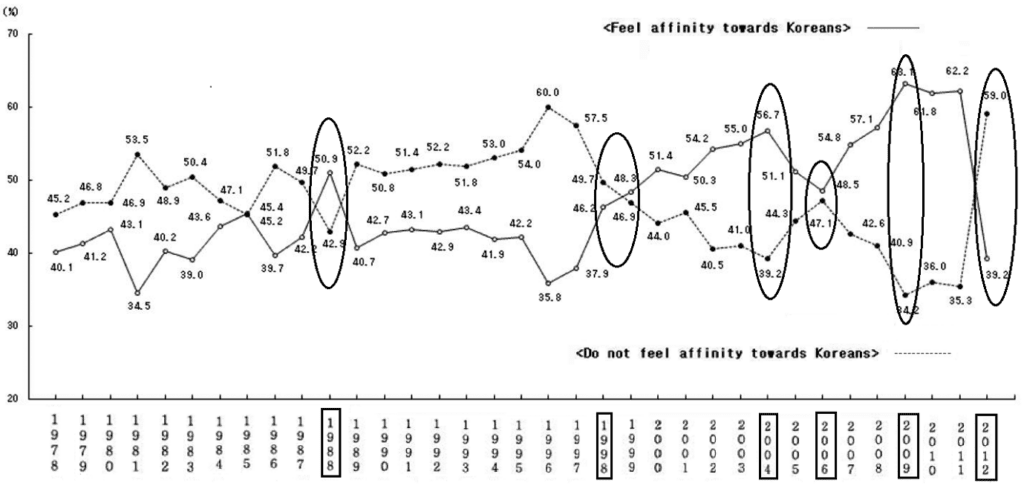
According to Figure 1, before the emergence of the Korean Wave, Korea’s country image to the Japanese was negative. That’s why Korea’s country image to the older generation in Japan was made that firebombs and tear gas were rampant under military dictatorship through mainstream mass media. Japan’s younger generations were not interested in or concerned about Korea. As a result, the rate at which Japanese did not feel affinity for Korea was higher than the rate at which they felt affinity except in 1988 when the Seoul Olympic games took place. In 1988 the rate of affinity for Koreans was higher than any other year before.
Since the Korean government officially started importing Japanese pop culture in 1998, the rate at which the Japanese felt affinity for Koreans also started to increase. In 2004 when the Korean Wave reached the pinnacle and in 2009 when the Korean Wave began to be revitalized by K-Pop, the rate at which Japanese felt affinity for Koreans went up again.
In contrast, this rate decreased in 2005 and 2006 when news on Korean demonstrations against Japan were massively reported by mainstream news media and on Internet sites in Korea and Japan. Above all, 2005 is the first year that the comic Hate-Korean Wave was published. YAMANO Sharin, who illustrated the comic books about hating Korea, was originally a web cartoonist and had participated in activities on 2Channel. From 2003, he continued to draw web cartoons on hate-Korea but did not get the opportunity to publish them. When the territorial disputes over Dokdo Island and Japanese distortions of history textbooks became big issues in the spring of 2005, demonstrations against them erupted in Korea. During these years, mainstream news media and the Internet sites in Korea and Japan, massively reported only the vigorous demonstrations on those issues-at-the-time, and they referred to them as »anti-Japan demonstrations«. Korean articles on the issues were disseminated among Japanese websites. This social atmosphere acted as a driving force for the publication of the comic Hate- Korean Wave in Japan.9 JUNG (2010).
During this time the negative issues on social and political grounds increased the negative perception and emotions towards each other. It is worth noticing that the rate at which Japanese felt affinity for Koreans was higher than the rate at which they did not. It is assumed that the Korean Wave plays a role as a buffer against the worsening relationship. In this sense, The Korean Wave’s quantitative and qualitative expansion within Japan and the various networks and cultural practices based on this expansion is a significant one beyond the economic and industrial performances between Korea and Japan.
Unfortunately, the rate at which Japanese didn’t feel affinity for Koreans sharply increased from 35.3% in 2011 to 59.0% in 2012. At the same time, the rate at which Japanese felt affinity for Koreans sharply decreased from 62.2% in 2011 to 39.2% in 2012. What was the reason for this transition? In 2012, the relationship between Korea and Japan worsened again related to the territorial disputes over Dokdo Island. Many people consider the worsening of the political and diplomatic situation on the national level as the reason. But it seems the situation is more complex than that.
The cyclic processes of information through mass media and the internet in Korea and Japan
Many Japanese audiences of the Korean Wave have become highly interested in information and news related to Korea, as well as Korean pop culture. So, they try to gather more information on Korea and Korean pop culture, and to conduct active cultural practices through varying channels and courses. Most of all, audiences of the Korean Wave utilize channels such as the various media and both official and unofficial fan clubs in order to gain more information and news on Korea and the Korean Wave. In the process, websites are indispensable means of gathering information and conducting cultural practices by Japanese audiences.
Major Korean newspapers provide news through their own websites in Japanese. Additionally, news and information distributed through the Internet circulate throughout Korea and Japan via automatic computer translation programs and websites for translation.10 MURAKAMI Kazuhiro (2007): Tsushima being in internet: About the hate-Korea, in: ISHIDA / KIMURA / YAMADA (eds.): Media Sociology of Post- Korean Wave, (Kyoto). However lots of Korean news media mainly approach the Korean Wave in terms of unidirectional effects and marketing approach rather than cross-understanding and intercultural communication. Furthermore, some of them tend to sensationalize and exaggerate the issues related to the Korean Wave and the hate-Korean Wave in Japan. Korean news sites translate some of the vicious opinions on 2Channel and sensationally introduce them as if they were the general opinion of the Japanese public, and in turn Koreans’ critical responses to them are delivered to Japan through the Internet. This process circulates repeatedly.
Meanwhile, studies about the gap between the Japanese public opinion as a whole and the hate-Korea discourses emerged. JUNG & YU (2013) did an analysis on the reporting attitude, theme and prevalent frames in news relating to the Korean Wave in the mainstream newspapers in Japan during 2009 to 2012. A total of 347 articles from Japan’s Yomiuri Simbun and Asahi Simbun have been analyzed. The findings showed that in Japanese newspapers more Korean Wave news were reported from a positive than from a negative perspective, and that cultural interest was the most predominant category followed by stories about comparison/competition/cooperation. Above all, the studies found that the number of news with warning/derogation topics was smaller than other categories.
In 2011, Korean mainstream news media and a lot of websites extensively reported on Japanese people participating in demonstrations against one of their own broadcasting companies, Fuji TV, for airing too many Korean TV dramas and programs. In Korea, the demonstrations were reported on as » hate Korea demonstrations« and presented as general public opinion in Japan. Korean people who accessed the news on Korea’s news media criticized Japanese people severely. In turn, Japanese people who accessed news related to criticism against Japan by Koreans on websites criticized Koreans. But, Japanese mainstream newspapers have been reporting on the issues in just short news briefs and criticizing the demonstration.11 JUNG Soo-Young & YU Sae-Kyung (2013): An analysis of the news coverage of the Korean Wave: With special reference to Chinese and Japanese newspapers, Journal of Communication Research, Vol.50, No.1 (2013).
It is assumed that the same processes apply to issues in political, social, historical, and diplomatic fields including the territorial disputes over Dokdo Island. In other words, it is hard to understand the true nature of the Korean Wave and the hate-Korea discourses through the representation by the mass media and the Internet. Furthermore, much of the data and reasons that support the hate-Korea discourses in Japan, and the anti-Japan discourses in Korea have been produced in mainstream mass media and the Internet.12 For example, when the Korean media reported that the Japanese posted libelous comments about Yu-Na Kim, famous Korean figure skater, on 2Channel, Korean netizens intensively logged on to the website 2Channel, and paralyzed it (LEE Jung-Ho (2010): Netizens attack the Japanese Internet site slandering Yuna Kim, Maeil Business Newspaper, March). 2Channel deemed this attack as cyberterror, and contacted an FBI special agent for cybercrime at the San Francisco office to investigate this case (ITmedia, March 5, 2010, http://www.itmedia.co.jp /news/ articles/1003/05/news085.html).
In addition those cyclic processes through various digital media including the Internet have been expanding more quickly and more widely by the advance of IT (Information Technology) and its spread. Consequently, it is assumed that the transition of Japanese feelings of affinity toward Korea in 2012 was mainly due to the cyclic processes through digital media and the Internet.
CONCLUSION
The Korean Wave is changing quantitatively and qualitatively. Even now when the raging wind of the Korean Wave is blowing, the Korean Wave and the hate Korean Wave coexist and spread simultaneously as sort of subcultures in Japan.
Some people insist that there is a gap between perception and reality in Korea and Japan. In other words, Koreans tend to interpret the Korean Wave within the context of political relationships between Korea and Japan, but Japanese tend to simply enjoy Korean pop culture.13 CHU Yeong-Ha (2007): The Korean Wave in Japan, See in Korea and Japan, (Seoul). Perhaps that may be true to some extent, but there are a lot of Japanese and Korean people whose preference for pop culture has been expanded to interest in each other’s social, political and historical areas.14 JUNG Soo-Young (2011): A study on exploring the Korean Wave landscape and cultural practice of audiences in Japan, Media, Gender & Culture, Vol. 20 (2011).
Intercultural communication is an interaction among people with various cultural backgrounds, and the key is in their ability to understand one’s own self as well as other cultures. Therefore, according to Samovar and Porter, the first step in preventing potential problems – for example, reducing uncertainty, stereotyping, prejudice, racism, culture shock, and ethnocentrism – in the intercultural communication process is to meet each other and recognize each other’s differences, and to make efforts to understand each other’s cultural backgrounds and social contexts.15 Samovar, Larry A. & Richard E. Porter (2004): Communication between Cultures.
In addition, we should acknowledge that the mass media and the Internet not only convey and create the Korean Wave discourse, but also define properties and establish directions. The mass media and the Internet have a negative function by fostering the hate-Korea discourses in Japan and the anti-Japan discourses in Korea, as well as a positive function by activating intercultural communication between Korea and Japan. Therefore, we need to avoid unconditional dependence on the mass media and information on the Internet.
Finally, as this paper mentioned above, we should avoid the unidirectional marketing approach towards each other on pop culture phenomena related to national branding.
This paper aims to upgrade the Korean Wave as a cultural and social exchange in terms of a favorable relationship between Korea and Japan. But, one of the limitations in this paper is that it just focused on the Korean Wave and Korea’s country image in Japan. Future research needs to look at the reception of Japanese pop culture and Japan’s country image in Korea.